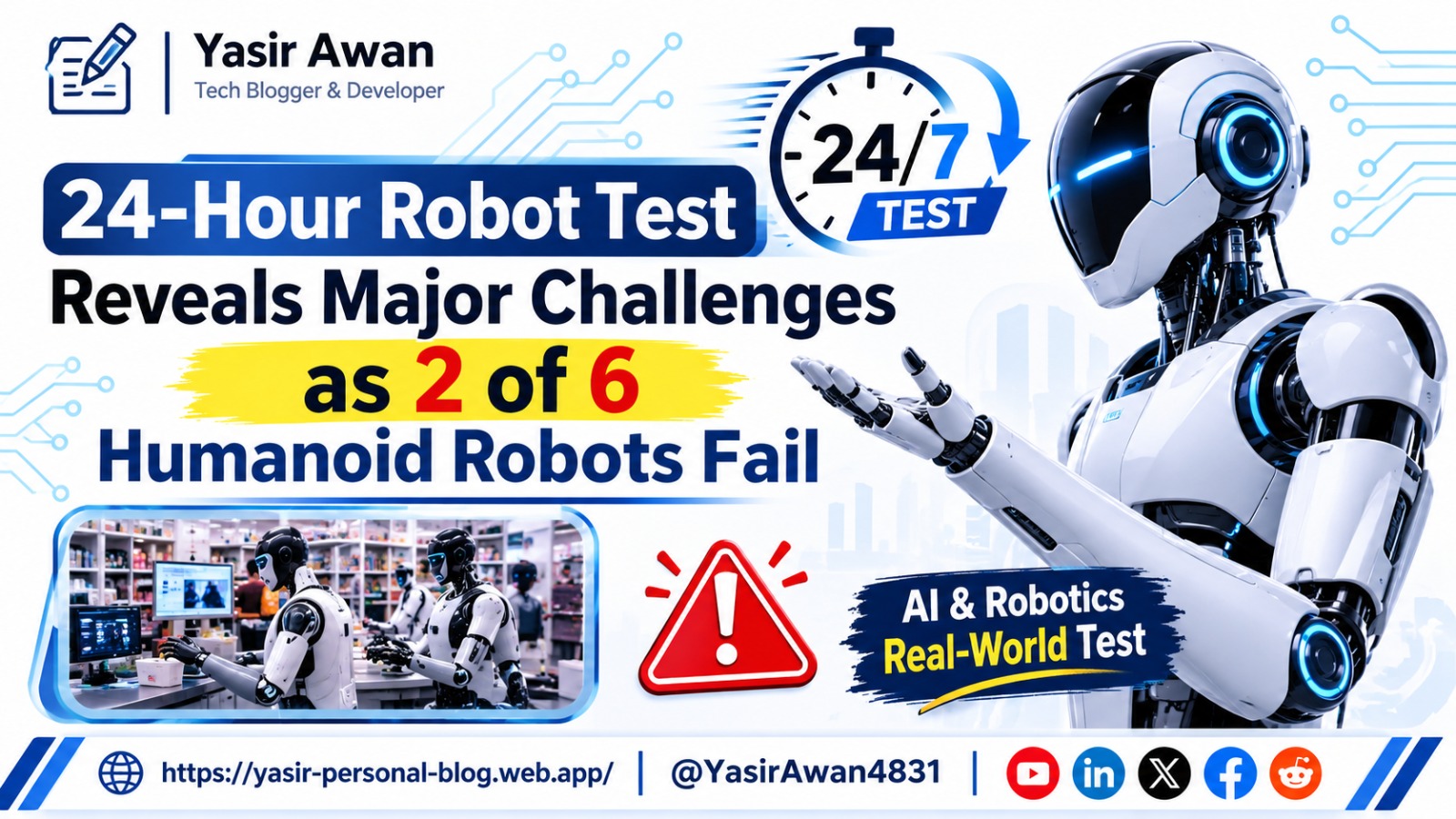
A 24-Hour Test Puts Humanoid Robots to Work
A 24-hour experiment at a supermarket in Shanghai, China, has revealed both the potential and limitations of humanoid robots in real-world working environments. Six humanoid robots participated in the test, but only four managed to complete their assigned responsibilities satisfactorily, while two failed to perform their duties as expected.
The experiment was organized by Chinese robotics company AgiBot under the title "Robots Never Take a Day Off." Its primary objective was to evaluate how effectively humanoid robots could handle everyday supermarket operations during different shifts, including busy daytime hours, evenings, overnight operations and the morning breakfast rush.
Robots Completed 1,730 Tasks During the Experiment
During the 24-hour trial, the six robots collectively completed 1,730 tasks involving customer assistance, product handling, food preparation, shelf monitoring and cleaning.
The reported activities included:
683 customer greetings: Welcoming and assisting supermarket visitors.
369 product-handling tasks: Picking up and delivering items.
147 coffee preparations: Preparing coffee orders for customers.
126 hot-food orders: Handling and preparing hot food requests.
277 shelf inspections: Checking shelves and restocking products.
128 cleaning tasks: Cleaning tables and maintaining store areas.
The experiment provided an opportunity to observe how robots performed under different working conditions and changing customer demands throughout the day and night.
Why Did Two Humanoid Robots Fail?
Despite completing a large number of tasks, two robots encountered difficulties that highlighted important limitations in current robotics technology.
A Cleaning Robot Lost Its Way
One robot assigned to cleaning duties encountered a full trash bin along its planned route. Instead of handling the situation effectively, it deviated from its designated path, moved outside the supermarket and failed to return to its assigned position.
This incident demonstrated how unexpected obstacles and changes in real-world environments can affect a robot's navigation and decision-making capabilities.
A Shelf-Monitoring Robot Struggled With Restocking
The second robot experienced difficulties monitoring supermarket shelves and restocking products. It was unable to respond effectively to product sales and changing inventory demands, making it difficult to perform its assigned responsibilities.
These failures demonstrate that performing individual programmed tasks is not the same as independently managing complex operations in a dynamic retail environment.
The Challenge of Making Robots Truly Autonomous
According to international media reports, experts believe that humanoid robots still face significant challenges despite improvements in artificial intelligence.
Modern AI systems can process information, recognize objects and make decisions. However, translating that intelligence into reliable physical actions remains a major technical challenge.
Robots must coordinate their sensors, mechanical components, navigation systems and decision-making processes to operate successfully in unpredictable environments.
Even relatively simple situations, such as encountering an unexpected obstacle or responding to changing customer demands, can expose weaknesses in robotic autonomy.
Robot Dogs Also Face Real-World Challenges
Similar difficulties have also been reported in the development of autonomous robotic systems.
Last month, US-based company Dimensional announced plans to use human assistance to improve the ability of its robotic dogs to navigate urban environments and operate more independently.
According to the company's founder, Stash Pumekhtar, the experiment highlighted how AI-powered systems can still struggle to control physical machines and hardware effectively.
The company has reportedly purchased 100 robotic dogs and 50 humanoid robots from different manufacturers in China, Germany and the United States.
Among the machines are robotic dogs manufactured by Chinese company Unitree, including models valued at approximately $2,000 that have been seen on the streets of San Francisco.
What Does This Mean for the Future of Robotics?
The Shanghai supermarket experiment demonstrates that humanoid robots are becoming increasingly capable of performing practical tasks in commercial environments. However, their performance also shows that fully autonomous operation remains a significant challenge.
Although four out of six robots performed satisfactorily, the failures of the other two highlight the importance of improving navigation, hardware control, environmental awareness and independent decision-making.
As robotics technology continues to advance, companies will need to focus not only on artificial intelligence but also on making robots reliable, adaptable, and capable of handling unexpected situations.
The future of robotics is promising, but the journey toward truly independent machines is still far from complete.